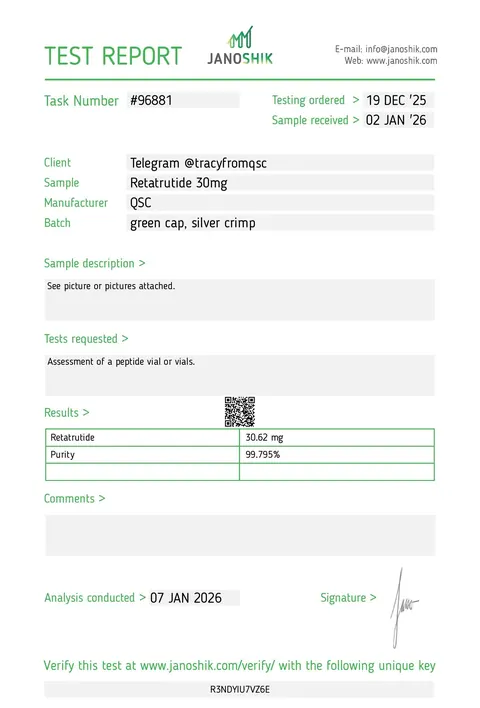
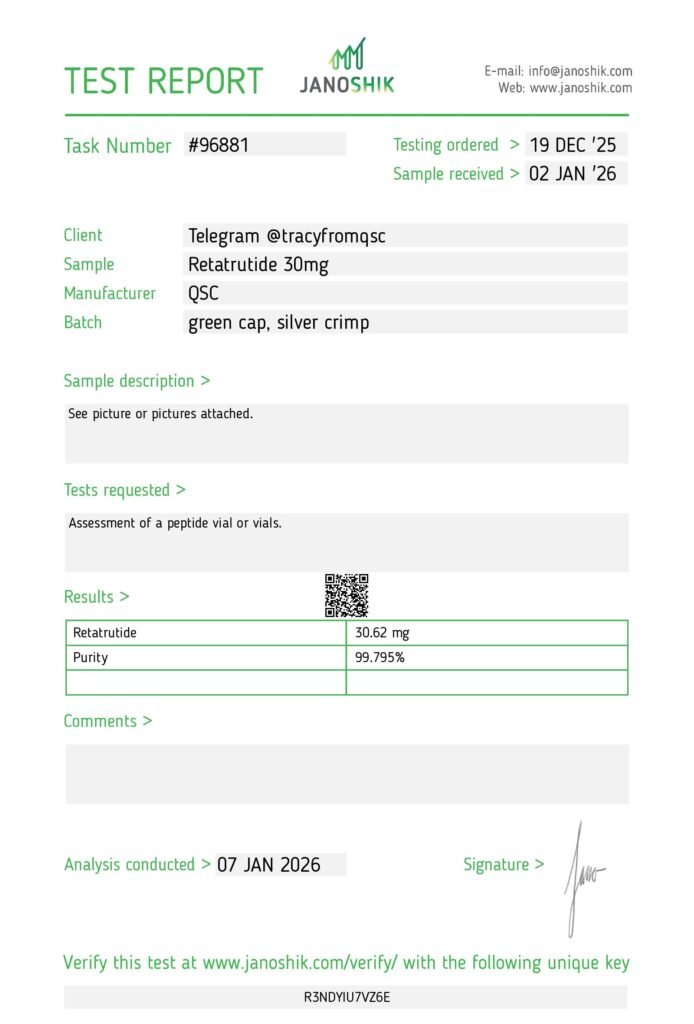
A certificate of analysis (COA), often called a test report, is the document a laboratory issues after analysing a sample. For research peptides it is the closest thing you have to an independent check on what is in the vial. This guide walks through each part of a typical report, using the layout of the Janoshik Analytical reports we publish for every product, and explains what a COA can and cannot tell you.
1. Who tested it, and when
The header identifies the laboratory and gives a task number, a unique reference for that analysis. You will usually also see three dates: when testing was ordered, when the sample was received and when the analysis was conducted. The analysis date tells you how recent the result is.
2. The sample details
- Sample: the name the sample was submitted under, for example “NA semax amidate 30mg”. Laboratories record this as the client wrote it, so it may not exactly match a retailer’s product name.
- Client and manufacturer: who submitted the sample and who made it.
- Batch: a batch number, or sometimes only a description such as a cap colour. A specific batch number lets you match a report to a particular production run; a description is less precise.
3. Tests requested
This line states what the laboratory was asked to measure, and it matters: a report only covers the tests that were ordered. A request such as “assessment of a peptide vial” typically covers identity, quantity and purity, while a blend or content analysis may report only the amount of each component.
4. Results: content and purity
Most peptide reports give two kinds of result:
- Content (mg): the measured amount of the compound in the vial. Compare it with the labelled amount: a 30 mg vial that measures 30.62 mg is close to its label. Small differences either way are normal; large shortfalls are worth asking about.
- Purity (%): the proportion of the detected material that is the target peptide, usually determined by HPLC. A purity of 99.7% means the target peptide made up 99.7% of what the method detected. Some reports note that purity “includes peptide peaks only”, meaning non-peptide material such as salts or water is not part of the calculation.
Blends are often reported differently. A multi-peptide vial may list the identity and amount of each component without an overall purity figure, because purity is hard to define for a mixture. Our article on how peptide purity is tested explains the methods behind these numbers.
5. Comments
The comments box is where the laboratory notes anything that affects how to read the result, such as the scope of the purity assessment. Always read it.
6. The verification key
At the bottom of a Janoshik report is a unique verification key. Entering it at janoshik.com/verify brings up the laboratory’s own record of the test, so you can confirm the PDF you are reading matches what the laboratory issued.
What a COA does not tell you
- It describes the sample tested. A report applies to the vial that was analysed. How well it represents other vials depends on whether they come from the same batch.
- It covers only the tests ordered. If sterility, endotoxins or heavy metals were not requested, the report says nothing about them.
- It is not a statement about use. A COA is an analytical record. It says nothing about effects in people or animals, and research materials are not approved for human use.
Where to find our reports
Every Apex BioLabs product page includes its report, transcribed field by field with a link to the unedited PDF. All reports are also collected in our test report library, each with its verification key.