Selank and Semax are related synthetic heptapeptides. Our versions carry two common chemical modifications, an N-terminal acetyl group and a C-terminal amide. This guide explains the sequences, what those modifications change, and what the independent reports found. It describes chemistry only, not effects in people or animals.
Two peptides with a shared ending
Both peptides were developed at the Institute of Molecular Genetics of the Russian Academy of Sciences, and both end in the same three residues, Pro-Gly-Pro.
| Peptide | Sequence | Built from | Unmodified formula and weight |
|---|---|---|---|
| Selank | Thr-Lys-Pro-Arg-Pro-Gly-Pro | Tuftsin (Thr-Lys-Pro-Arg) plus Pro-Gly-Pro | C33H57N11O9, about 751.9 g/mol |
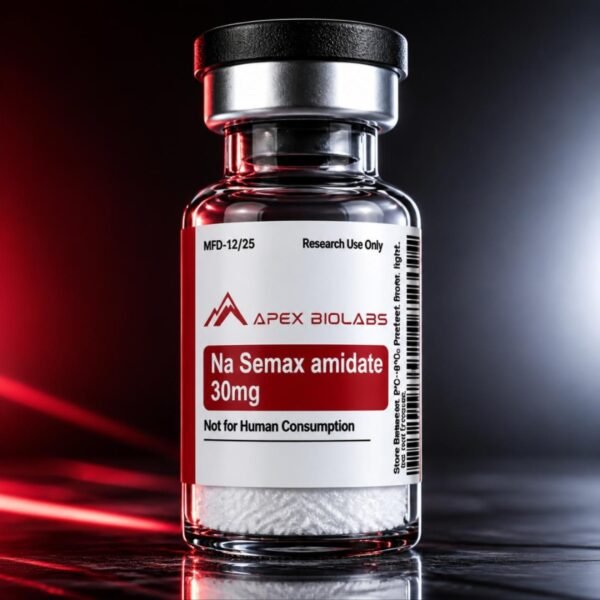
| Semax | Met-Glu-His-Phe-Pro-Gly-Pro | The ACTH(4–7) fragment plus Pro-Gly-Pro | C37H51N9O10S, about 813.9 g/mol |
What “N-acetyl” and “amidate” mean
A plain peptide has a free amine group at one end (the N-terminus) and a free carboxylic acid at the other (the C-terminus). The two modifications cap both ends:
- N-acetyl (NA): an acetyl group is added to the N-terminal amine, removing its positive charge.
- Amidate: the C-terminal carboxylic acid becomes an amide, removing its negative charge.
Capping both ends is a standard technique in peptide chemistry, because many of the enzymes that break peptides down (exopeptidases) work by trimming residues from the free ends. Together the two changes add about 41 g/mol to the molecular weight.
What the lab reports show
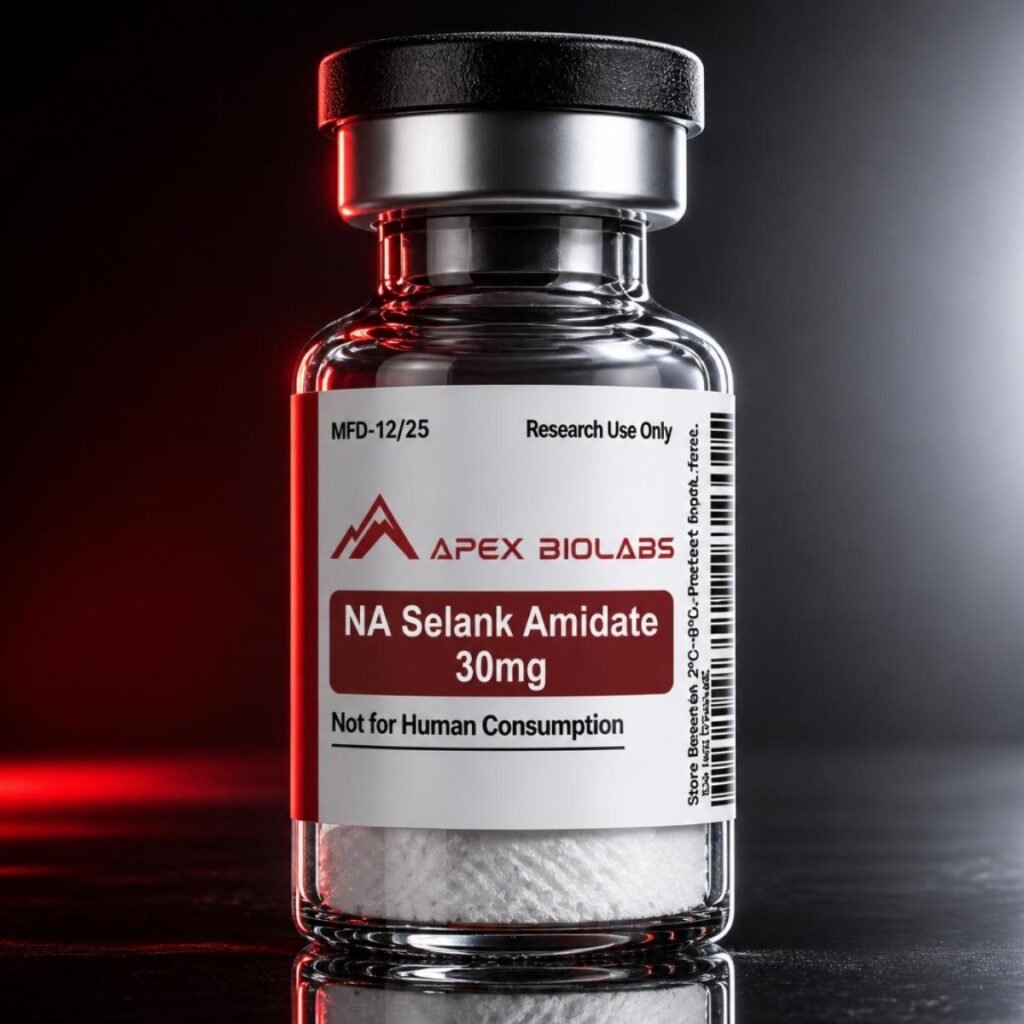
Both are supplied as 30 mg of lyophilised powder in a 3 mL vial. The current reports:
| Product | NA-Selank Amidate 30mg |
|---|---|
| Label | 30 mg |
| Measured: N-Acetyl Selank Amidate | 31.73 mg |
| Purity | 99.771% |
| Report | Janoshik #132849, analysed 30 Mar 2026 |
| Verification key | SBQPFAF3BVJT |
| Product | NA-Semax Amidate 30mg |
|---|---|
| Label | 30 mg |
| Measured: N-Acetyl Semax Amidate | 29.07 mg |
| Purity | 99.424% |
| Report | Janoshik #165289, analysed 28 May 2026 |
| Verification key | Q2ZKKQP84UAW |
Storage and handling
- Unopened, long term: −20 °C, protected from light.
- Unopened, short term: 2–8 °C for up to several weeks.
- Let the vial reach room temperature before opening.
- After reconstitution: keep at 2–8 °C and write the preparation date on the vial.
In our range
For laboratory research use only. Neither peptide is registered on the Australian Register of Therapeutic Goods, and nothing on this page describes use in humans or animals.