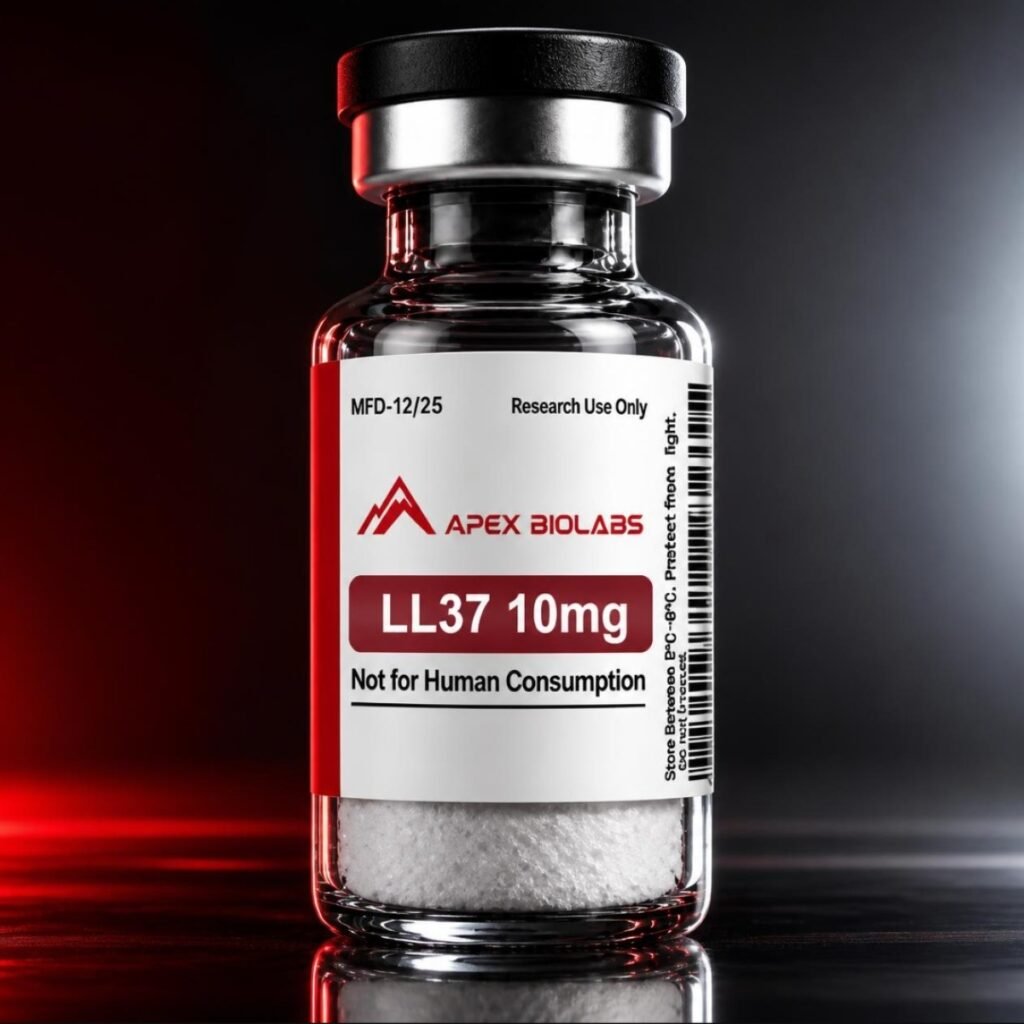
LL-37 is a reference compound in laboratory research on host-defence peptides. This guide covers where it comes from, what its sequence looks like, a few handling points that follow from its chemistry, and what the independent report on our 10 mg vial found. It describes chemistry only, not effects in people or animals.
Where LL-37 comes from
Cathelicidins are a family of host-defence proteins found in many mammals, named after the cathelin-like domain they share. Humans have a single cathelicidin, hCAP18 (human cationic antimicrobial protein, 18 kDa). LL-37 is the peptide released from its C-terminal end.
The name describes the peptide itself: it begins with two leucines (L, L) and is 37 amino acids long.
Sequence and structure
LLGDFFRKSKEKIGKEFKRIVQRIKDFLRNLVPRTES
- Molecular formula C205H340N60O53, molecular weight about 4,493 g/mol.
- Strongly cationic: 11 basic residues (6 lysine, 5 arginine) against 5 acidic ones, a net charge of about +6 at neutral pH.
- Amphipathic: in membrane-like environments it folds into an α-helix with charged residues on one face and hydrophobic residues on the other.
Handling notes that follow from its chemistry
Positively charged, amphipathic peptides tend to stick to surfaces. At low concentrations a noticeable share of LL-37 can adsorb to plastic and glass, which is why many laboratories prepare it in low-binding tubes and avoid unnecessary transfers.
- Unopened, long term: −20 °C, protected from light.
- Unopened, short term: 2–8 °C for up to several weeks.
- Let the vial reach room temperature before opening.
- After reconstitution: keep at 2–8 °C and write the preparation date on the vial.
What the lab report shows
| Product | LL-37 10mg |
|---|---|
| Label | 10 mg |
| Measured: LL-37 | 9.97 mg |
| Purity | 99.666% |
| Report | Janoshik #215328, analysed 31 Jul 2026 |
| Verification key | CADGTYJI5DVH |
Janoshik’s report adds a note that the purity assessment includes peptide peaks only. In other words, the 99.666% figure compares LL-37 with other peptide material in the sample; non-peptide components, such as residual counter-ions and moisture that any lyophilised peptide carries, are not part of that number. The measured content of 9.97 mg against 10 mg on the label (report #215328) is the figure for how much LL-37 is in the vial.
Our guide on how to read a peptide COA explains content and purity in more detail.
In our range
For laboratory research use only. LL-37 is not registered on the Australian Register of Therapeutic Goods, and nothing on this page describes use in humans or animals.