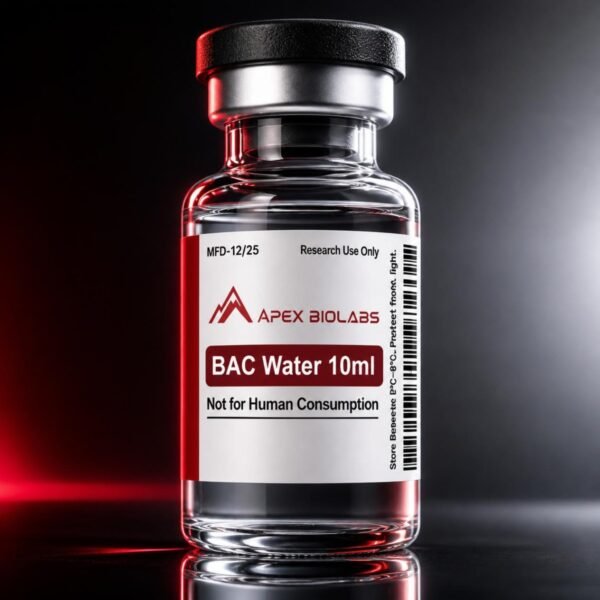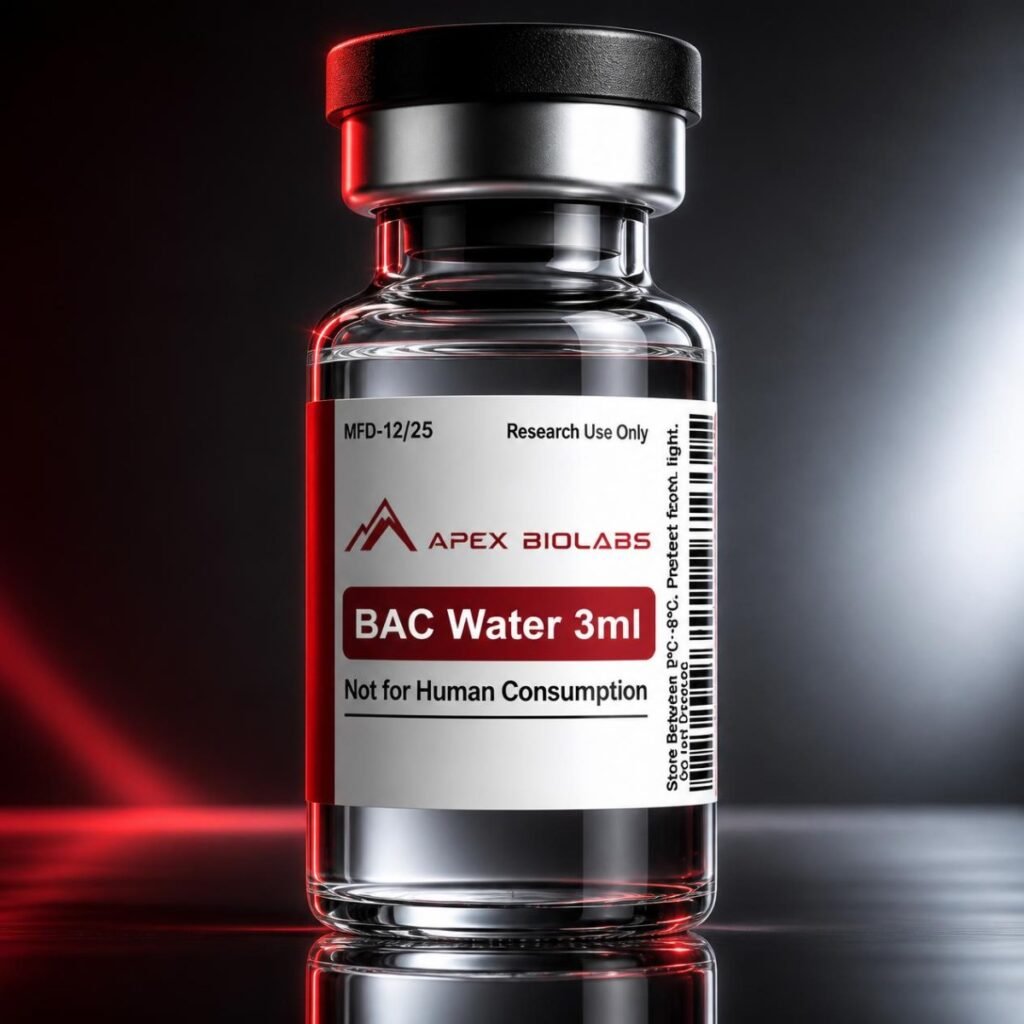
Bacteriostatic water is the standard liquid laboratories use to reconstitute lyophilised (freeze-dried) peptides. This guide explains what it is, how it differs from sterile water, how to choose a vial size, and what the independent lab report on our vials found.
What makes water “bacteriostatic”
Bacteriostatic water is sterile water with a small amount of benzyl alcohol added as a preservative. Benzyl alcohol (C7H8O, about 108.1 g/mol) is the simplest aromatic alcohol. At this concentration it does not sterilise anything; it stops most bacteria from multiplying. That is what “bacteriostatic” means: growth is held back, rather than organisms being killed.
The standard formulation contains 0.9% benzyl alcohol, which is 9 mg per mL.
Bacteriostatic water vs sterile water
| Bacteriostatic water | Sterile water | |
|---|---|---|
| Preservative | Benzyl alcohol | None |
| Once opened | The preservative limits bacterial growth, so an opened vial can be used across several laboratory preparations | Intended for single use; discard what is left |
| Typical laboratory use | Reconstituting lyophilised peptides that will be used over a period of time | Single preparations, or work where benzyl alcohol must be avoided |
Benzyl alcohol is compatible with most research peptides. If a protocol calls for a preservative-free solvent, sterile water or a specified buffer is used instead.
What the lab report shows
Janoshik Analytical ran a qualitative and quantitative analysis to confirm the preservative and measure how much is present. Our 3 mL and 10 mL vials come from the same tested product:
| Product | Bacteriostatic Water 3mL |
|---|---|
| Label | 3 mL |
| Measured: Benzyl alcohol | 10.15 mg/mL |
| Purity | Not part of this test |
| Report | Janoshik #110963, analysed 02 Mar 2026 |
| Verification key | XQQ9EAULW39K |
The measured 10.15 mg/mL of benzyl alcohol, in the batch tested for report #110963, is about 1.0%, a little above the standard 0.9% figure.
3 mL or 10 mL?
The volume a laboratory adds to a vial depends on the concentration its protocol needs, so the right size depends on how many vials you are preparing:
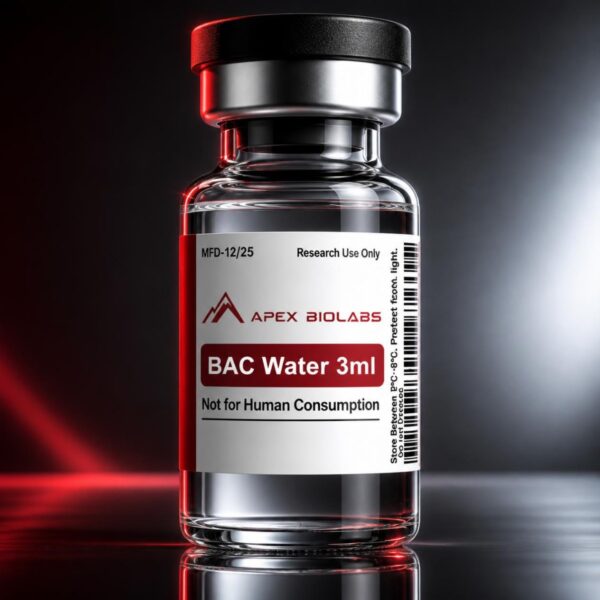
- 3 mL suits a single preparation, with little left over once opened.
- 10 mL suits preparing several vials over time from one bottle.
Storage and handling
- Store below 25 °C, protected from light.
- Write the date on the vial when you first open it, and follow your laboratory’s discard protocol for opened vials.
- Keep the vial closed when not in use, and handle it with your laboratory’s standard aseptic technique to keep contamination out.
For the peptides themselves, see lyophilised peptides and storage.
In our range
For laboratory research use only. This product is not registered on the Australian Register of Therapeutic Goods, and nothing on this page describes use in humans or animals.